Your dog doesn't have to spend the afternoon in a forest to come home with a tick. That's the part most owners don't find out until it's already happened. A quick walk around the block, a romp in a neighbor's backyard, a sniff through some overgrown grass at the edge of a parking lot — any of those can do it.
Tick season is ramping up across most of the United States right now, and while the basics of prevention haven't changed, there's a lot of nuance that gets glossed over in a single product recommendation. This post covers the regional picture, where ticks are actually hiding, what to look for on your dog, and how to build a realistic prevention routine — not just during peak season, but year-round.
Tick season looks different depending on where you live

One of the most common misconceptions is that tick season is a uniform spring-to-fall window. It's not. The timing, the species involved, and the associated disease risks shift considerably by geography.
The Northeast and Upper Midwest
These regions deal primarily with the black-legged tick (also called the deer tick), which is the main carrier of Lyme disease. Adults become active as soon as temperatures stay consistently above freezing — sometimes as early as late February or early March — and nymphs (the tiny, harder-to-spot juveniles) peak in late spring and early summer. Nymphs are responsible for the majority of Lyme transmissions in dogs and people because they're about the size of a poppy seed and are easy to miss.
The South and Gulf Coast
The American dog tick and the lone star tick dominate here. Lone star ticks are aggressive, fast-moving, and active nearly year-round in states like Texas, Florida, Georgia, and the Carolinas. They don't transmit Lyme disease, but they do carry ehrlichiosis and Rocky Mountain spotted fever — both of which can be serious. In the warmest parts of the South, there's no true "off season."
The West and Mountain States
The Rocky Mountain wood tick is common in higher elevations from spring through early summer, while the western black-legged tick (a close relative of the deer tick) is active along the Pacific Coast in wetter months. California dog owners, particularly those near coastal scrubland or oak woodlands, often underestimate their exposure because the climate doesn't feel like "classic" tick country.
No matter where you are, the practical takeaway is the same: check the CDC's tick surveillance data for your specific county if you want to know what species are circulating and when. National generalizations only go so far.
Where dogs are actually picking up ticks
Trail hiking is genuinely high-risk, but it's not the only risk. Ticks don't jump or fly — they "quest," which means they climb to the tips of low vegetation and wait for a warm-bodied host to brush past. That behavior makes any patch of tall grass, leaf litter, or dense ground cover a potential hotspot, regardless of how remote or manicured it looks.
Common overlooked tick habitats include:
- The border where a mowed lawn meets an unmowed edge or wood line
- Leaf piles left over from fall, especially if they're damp
- Ornamental groundcover plants like pachysandra or English ivy
- Dog parks — particularly the shaded, less-trafficked corners
- Areas where deer, rabbits, or rodents regularly travel (even suburban yards)
Your yard might look clean and still harbor ticks if it's adjacent to a neighbor's wilder property or if wildlife cuts through it regularly. A single deer walking through can deposit hundreds of tick larvae in one pass.
How to check your dog — and what you might be missing
Most people know to check behind the ears and around the neck. Fewer people check thoroughly enough in the places ticks prefer to hide once they've found their host: between the toes, in the groin folds, under the "armpits" of the front legs, around the tail base, and under the collar itself. On long-coated or double-coated dogs, a visual check isn't enough — you have to part the fur down to the skin.
It helps to do this methodically after every outing during peak season. Run your fingers slowly against the grain of your dog's coat, feeling for small bumps. An attached tick feels different from a skin tag or a scab — it's usually round, firm, and will have visible legs if you look closely.
If you find an attached tick, use fine-tipped tweezers or a dedicated tick removal tool, grip as close to the skin as possible, and pull upward with steady, even pressure. Don't twist, crush, or apply heat. After removal, clean the bite area with rubbing alcohol and wash your hands. Save the tick in a sealed bag if you want to have it identified later.
When to call your vet
A tick bite alone isn't always cause for alarm, but some situations warrant a call: if you're unable to remove the tick cleanly, if the bite site becomes red, swollen, or develops a bullseye-style rash, or if your dog develops lethargy, loss of appetite, joint stiffness, or fever in the days to weeks following a known tick exposure. Tick-borne illnesses can take time to manifest symptoms, so don't assume your dog is fine just because nothing happened in the first 48 hours. Your vet can run a 4Dx or similar panel to check for the most common tick-borne diseases.
Building a realistic prevention routine
No single measure eliminates tick risk entirely — the goal is layering protection so that the odds of a successful attachment stay low.
Prescription preventatives: Oral and topical flea-and-tick preventatives (isoxazolines like afoxolaner, fluralaner, and sarolaner, or topicals like permethrin-based products for dogs) are the most effective tools available. Talk to your vet about which class makes sense for your dog's size, health history, and lifestyle. These are not optional supplements — they're the foundation of the routine.
Yard management: Keep grass trimmed short, clear leaf litter, create a gravel or wood chip buffer between your lawn and any wooded edges, and discourage wildlife from entering the yard where possible. This won't make your yard tick-free, but it meaningfully reduces habitat.
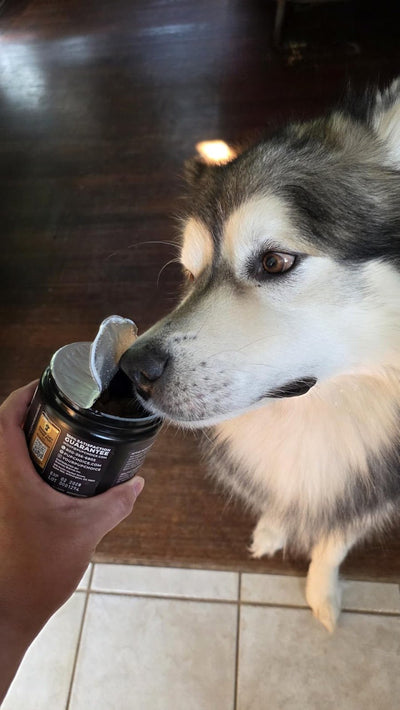
Skin and coat health: A dog with a healthy, intact skin barrier is better equipped to handle everything the environment throws at it — including minor irritation from tick bites or the topical preventatives used to prevent them. Supporting your dog's coat from the inside out with a daily omega-3 supplement that includes wild salmon oil, biotin, and zinc can help maintain that barrier, especially during the warmer months when dogs are spending more time outdoors and in water.
Immune resilience: Tick-borne pathogens challenge the immune system, and a well-supported gut is foundational to immune function. If your dog isn't already getting consistent gut support, adding a probiotic formulated with prebiotics and digestive enzymes is a reasonable year-round baseline — not a tick preventative, but a way to keep your dog's overall defenses as strong as possible heading into a season that taxes them.
The goal is a dog who's well-protected, well-nourished, and checked consistently. Ticks are a manageable risk when you approach them systematically rather than reactively. 🐾

Frequently asked questions
Can my dog get ticks even if they're on a preventative?
Yes, though the risk is significantly reduced. Most oral preventatives work by killing ticks after they attach, not by repelling them. This means a tick may still get on your dog and briefly attach before dying — which is why checking your dog after outdoor time remains important even when they're on medication.
How quickly can a tick transmit Lyme disease to my dog?
For Lyme disease specifically, transmission from a black-legged tick typically requires the tick to be attached for 36 to 48 hours. This is why prompt removal matters. Other pathogens — including the one that causes Rocky Mountain spotted fever — can transmit much faster, sometimes within a few hours of attachment.
Are some dog breeds more at risk than others?
All breeds are susceptible to tick attachment, but there are a few nuances. Dogs with dense double coats can be harder to check thoroughly, which may mean infestations go undetected longer. Some breeds also appear to have a higher rate of clinical illness after Lyme exposure, though this isn't fully understood. Labrador Retrievers and Golden Retrievers, for example, seem to be more prone to Lyme nephritis (a severe kidney complication) than other breeds.
Is it safe to use tick preventatives on puppies?
It depends on the product and the puppy's age and weight. Most oral isoxazoline preventatives are approved for puppies 8 weeks and older, but minimum weight requirements vary. Some topical permethrin products are not safe for very young puppies at all. Always consult your vet before starting any preventative in a dog under 6 months.
What's the difference between a tick and a skin tag on my dog?
This is a surprisingly common question. An attached tick will typically be round, slightly raised, and firm — and if you look closely with good lighting, you'll see legs at the point where it's attached to the skin. Skin tags are usually softer, flatter, and don't have any external features. When in doubt, have your vet take a look, especially if you've found the bump after outdoor activity.
— Megan & the Pup Choice team